
What is the PMP passing score?
There is no fixed PMP passing score percentage. PMI does not publish a number like 61% or 70%, and chasing either figure will send your preparation in the wrong direction. The criterion-referenced scoring method PMI uses measures your performance against a predetermined competency standard, not against other test-takers and not against a static raw score.
What this means practically: the passing threshold shifts slightly depending on how difficult your specific exam form is. A harder set of questions lowers the raw score needed to demonstrate competency. An easier form raises it. The underlying standard stays fixed; only the threshold adjusts.
Your score report never shows a percentage. Instead, PMI reports your performance across three domains using four proficiency categories:
- Above Target — you exceeded the competency standard for this domain
- Target — you met the standard
- Below Target — you fell short
- Needs Improvement — significant gaps remain
Passing means demonstrating overall competency across all three domains: People, Process, and Business Environment. Strong performance in two domains can offset a weaker third, but a "Needs Improvement" in any single domain makes passing very difficult. PMI keeps the scaled score internal and never shares it with candidates. This protects exam integrity and prevents candidates from gaming a minimum threshold rather than building real project management knowledge.
The 61% myth has a real origin. Before 2005, PMI did publish a numerical passing score, and 61% was the figure in use for a period. That approach was retired in favor of the scaled, competency-based model still in use today.

How the PMP exam is structured and graded
The PMP exam consists of 180 questions across three domains, with four hours to complete them and two 10-minute breaks built in. PMI publishes the domain weightings directly:
- People — 33% of the exam
- Process — 41% of the exam
- Business Environment — 26% of the exam
Questions include multiple-choice, drag-and-drop, matching, and scenario-based formats. Not every question carries equal weight. Difficulty ratings are calibrated during question development, and harder questions contribute more to your scaled score when answered correctly.
The grading process works like this: each of your 180 answers is evaluated individually, then your performance is aggregated by domain. A statistical equating model adjusts for the difficulty of your specific question set, compares your result against PMI's competency standard, and produces a pass or fail decision. Domain proficiency levels replace raw scores entirely in the report you receive.
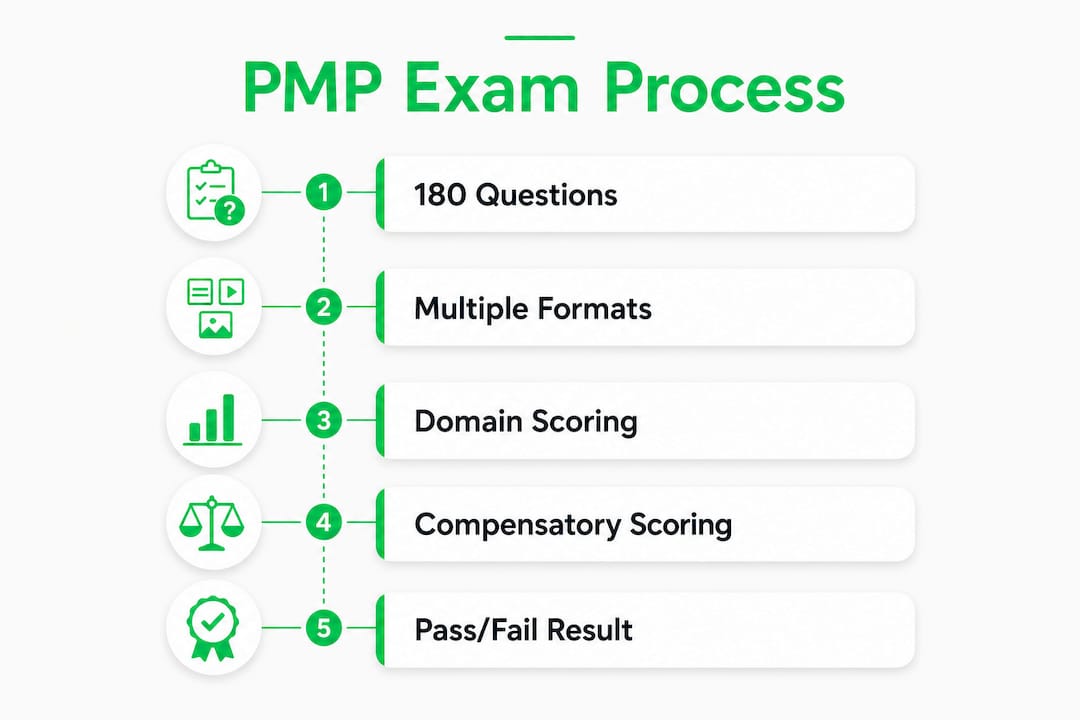
Compensatory scoring applies across domains. If you score "Above Target" in People and Process, that can offset a "Below Target" in Business Environment, provided your overall result clears the competency threshold. This is why candidates who focus on one domain at the expense of others often fail despite feeling prepared.
For Canadian candidates, the exam is available at Pearson VUE testing centers across the country or via online proctoring. PMI offers accommodations for language and accessibility needs; candidates should request these when scheduling through PMI's official portal.

Understanding the PMP exam pass rate and what it means
PMI does not release official global pass rate data. Independent training providers estimate the PMP first-attempt pass rate as moderate, meaning a meaningful share of candidates who sit the exam are not adequately prepared.
Statistic callout: Independent training providers estimate the PMP first-attempt pass rate at between 60% and 70%, meaning a meaningful share of candidates who sit the exam are not adequately prepared.
That number is a retrospective statistic, not a target. Knowing that roughly one-third of first-time candidates do not pass tells you something about preparation quality across the field. It says nothing about what score you personally need to hit.
The pass rate also fluctuates. Exam form difficulty varies, cohort preparation levels vary, and provider estimates differ. Fixating on the pass rate as a readiness benchmark is the same mistake as fixating on 61% as a passing score. Both are proxies that distract from the actual goal: demonstrating domain-level competency.
Pass rate and PMP exam passing criteria are not the same thing. The pass rate describes how many candidates succeed. The passing criteria describe what PMI requires of each individual candidate. Conflating them leads to under-preparation.
How to study effectively and actually pass the PMP exam
The most reliable preparation strategy targets domain proficiency, not a percentage. Here is what works:
- Aim for "Above Target" on full-length practice exams. Candidates who track domain proficiency and consistently score at that level on realistic practice tests show the strongest passing results. Anything in "Below Target" before your exam date is a signal to keep studying.
- Use scenario-based questions, not recall drills. The PMP exam tests how you apply project management judgment, not whether you memorized definitions. Practice questions should mirror real-world situations across all three domains.
- Build a structured study plan. Three months is a realistic timeline for most working professionals. Two weeks is possible only for candidates with deep project management experience and significant daily study hours.
- Review your domain breakdowns after every practice test. The score breakdown is your study guide. A weak Business Environment score tells you exactly where to spend the next week.
- Understand the PMP mindset. PMI favors proactive, stakeholder-focused, and process-driven answers. Candidates who internalize this approach answer scenario questions more accurately than those who rely on gut instinct.
- Use AI-powered platforms for personalized feedback. Platforms that adapt to your weak areas and deliver instant coaching after each question accelerate improvement faster than static study guides.
Pro Tip: Stop tracking your practice exam percentage as a pass/fail indicator. Instead, look at your domain proficiency breakdown after every full-length test. If any domain sits at "Below Target" consistently, that domain is your exam risk, not your overall score.
Canadian candidates can access both in-person and online training. Local providers offer blended formats that combine live instruction with self-paced content, which suits professionals balancing study with full-time work.
Which PMP training providers serve Canadian candidates best?
Three providers stand out for Canadian PMP candidates: Education Edge, Master of Project Academy, and Examboot. Each takes a different approach.
| Provider | Format | Key feature | Pass support | Pricing |
|---|---|---|---|---|
| Education Edge | Virtual live, in-person | PMI/IIBA certified trainers | Mock exams, money-back guarantee | Not publicly listed |
| Master of Project Academy | Virtual live, self-paced online | Flexible scheduling, 35 contact hours | very high first attempt pass rate | From $99/month (self-paced) |
| Examboot | Self-paced online, AI-driven | 280,000+ scenario questions, AI coaching | Personalized feedback, adaptive simulations | Tiered subscription |
Education Edge holds PMI and IIBA certified trainers and backs its courses with a money-back guarantee. Mock exams are included, and the focus on high pass rates through expert instruction makes it a strong option for candidates who prefer structured, trainer-led learning.
Master of Project Academy offers both a four-day virtual live course and a self-paced online option, both delivering the 35 contact hours PMI requires for exam eligibility. The self-paced plan starts at $99/month, and the virtual live course is priced at $1,079. The provider claims a very high first-attempt pass rate, which, if accurate, reflects the quality of its practice materials and instruction.
Examboot takes a different angle entirely. Rather than structured course delivery, it focuses on exam simulation and AI-driven coaching. The question bank exceeds 280,000 scenario-based questions mapped to PMP certification objectives. After each practice session, the AI identifies weak domains and adjusts your study focus automatically. For candidates who already have project management experience and need targeted exam practice rather than foundational instruction, Examboot's AI coaching fills that gap efficiently.
The right choice depends on where you are in your preparation. If you need structured instruction and the 35 contact hours, Education Edge or Master of Project Academy deliver both. If you have the hours covered and need high-volume, adaptive practice to sharpen domain proficiency, Examboot is built for exactly that.

Ready to stop guessing and start scoring "Above Target"? Examboot's AI-powered platform gives you access to over 280,000 PMP-aligned scenario questions, instant domain-level feedback, and a personalized coaching engine that adapts to your weak spots. Start your PMP prep and walk into exam day knowing your domains, not just your percentage.
Key Takeaways
The PMP passing score is a variable, competency-based benchmark with no fixed percentage, and candidates who focus on domain proficiency rather than chasing a number consistently outperform those who do not.
| Point | Details |
|---|---|
| No fixed passing percentage | PMI uses scaled, criterion-referenced scoring; no public number like 61% or 70% applies universally. |
| Four proficiency levels | Your score report shows Above Target, Target, Below Target, or Needs Improvement per domain, not a raw score. |
| First-attempt pass rate | Independent estimates place the first-time pass rate between 60% and 70%; thorough preparation is the differentiator. |
| Compensatory scoring applies | Strong performance in two domains can offset a weaker third, but "Needs Improvement" in any domain makes passing very difficult. |
| Domain-focused prep wins | Consistently scoring "Above Target" on full-length practice exams by domain is the clearest readiness signal available. |